The Complete Guide to Safe Towing in South Australia
Towing regulations in South Australia
The towing rules in South Australia are primarily concerned with towing mass, the brakes and lighting installed on your trailer (or caravan), and the speed limits at which you can legally and safely tow. Towing regulations are set out by the Department for Infrastructure and Transport, and if contravened SAPOL can issue fines and defect notices, and it can mean that your insurance is void if you are involved in an accident.
This guide breaks down the key requirements all trailer owners and drivers need to know to ensure safe towing in South Australia.
Understanding maximum towing mass is key to safety
In order to tow a trailer safely (including boat trailers and caravans) it's important to understand both the maximum load your trailer is capable of carrying and your vehicle towing capacity. It's helpful to note the following terms and what they mean.
Gross vehicle mass (GVM) is the maximum mass of a loaded tow vehicle as defined by the motor vehicle manufacturer.
Gross combination mass (GCM) is the maximum total weight of a loaded vehicle (i.e., with passengers) plus a loaded trailer, as set by the vehicle manufacturer.
Aggregate trailer mass (ATM) is the most relevant measure and is the total permitted mass of the trailer when it's not hitched to a towing vehicle. At Basic Trailers, this is the towing capacity that we use when describing our trailers.
Gross trailer mass (GTM) is the trailer's permitted mass when it's coupled to a towing vehicle.
Unloaded mass (tare) is the trailer's weight without a load.
If you are unsure about the weight of your trailer and vehicle combination, you can weigh it a public weighbridge before setting out on your trip to avoid the danger of being fined or invalidating your insurance.
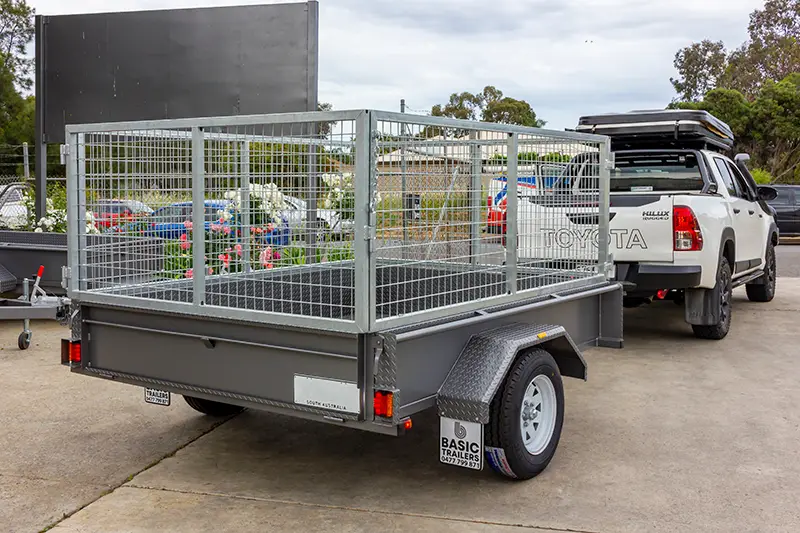
Speed limits for towing vehicles and licence requirements in South Australia
In South Australia, any person with a Class C licence is permitted under the state's towing regulations to tow a trailer with an aggregate trailer mass (ATM) up to 4,500kg.
The maximum length of a vehicle and trailer combination is 19 metres. In addition to adhering to towing weights, it is a requirement that trailers have safety chains and lights fitted.
The maximum speed limit for a vehicle towing a trailer (or caravan) is 100km/h. Passengers are not permitted to ride in a trailer when it is being towed on any road.
Trailer brake requirements in South Australia
The rules regarding trailer brakes are based on trailer mass and are essential to towing safety.
Trailers with a rated capacity up to 750kg ATM are not required to have brakes fitted. For trailers with an ATM up to 2,000kg, brakes must be fitted to at least one axle. Trailers with a rated capacity that exceeds 2,000kg ATM are required to have brakes fitted on all wheels as well as a breakaway system operated by the driver of the tow vehicle. Brake lights must also be fitted and functional on all trailers.
Towing a trailer without having the correct brake configuration can lead to a fine and insurance claims being void.
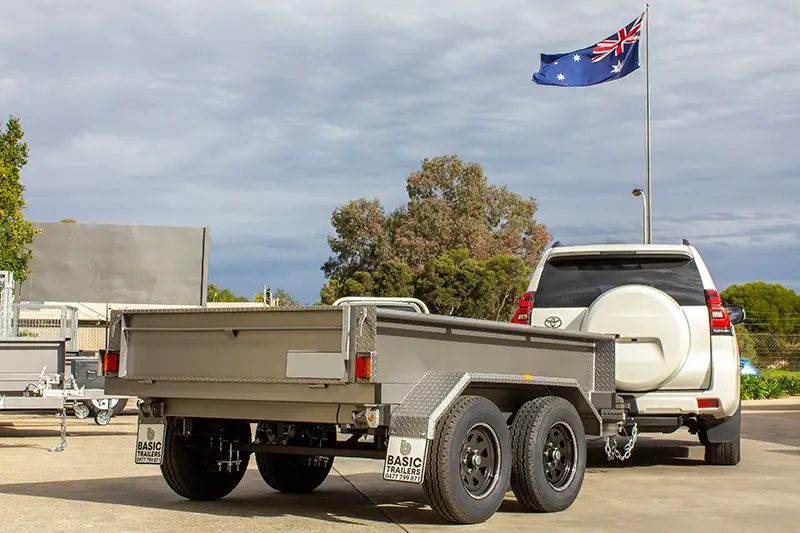
Trailer lights and other relevant towing rules
Understanding the law in South Australia regarding towing vehicles and trailer configuration is essential to keeping both you and other road users safe. Following are further towing regulations that you need to know to ensure you comply with the law.
Your trailer is required to be fitted with an appropriately rated tow coupling which must be fully secured before any trip.
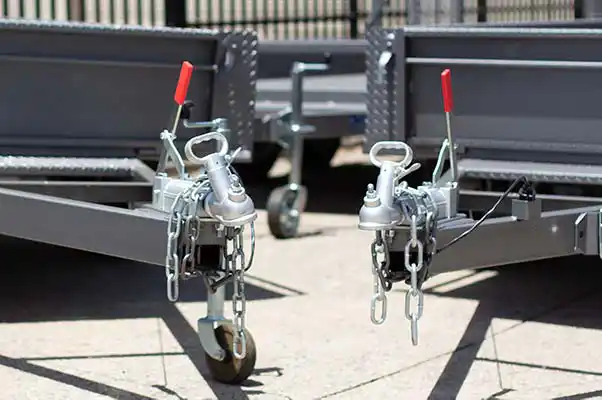
The trailer must be fitted with load-rated safety chains that comply with Australian Design Rules and which connect the trailer to the vehicle towing it. These add an extra layer of safety should the trailer become unhitched while on the road.
All trailer lights are required to act in unison with the lights on the towing vehicle. This includes indicators, brake lights, tail lights, reversing lights, hazard lights and the number plate light. Reflectors are also required on the side and rear, with the position and number of reflectors being determined by the trailer length.
Any load that you're carrying must not project more than 150mm beyond the trailer sides, and the maximum permitted width of trailer and load is 2.5m. If the load extends more than 1.2 metres beyond the rear of the trailer, a light or flag is required to be displayed.
Loading and towing your trailer safely
How a trailer is loaded and towed is more often the cause of problems on the road than structural or mechanical issues.
In particular, how the weight is distributed has a direct impact on the stability of the trailer on the road, so if the load is properly positioned when towing it can significantly reduce the danger of trailer sway.
To avoid sway, heavier items should be loaded on the floor of the trailer and slightly forward of the axles. Tailgates and ramps should be firmly secured and loose items in the load secured with straps or binders, using tie-downs if possible.
If you're driving on open stretches of country highways, passing trucks and road trains can cause trailer sway, so take care not to make any sudden steering movements.
Other safe towing tips include having extended mirrors fitted to the tow vehicle so you can see safely up to 20 metres behind you, and ensure that you carry a spare wheel for the trailer.
Talk to the team at Basic Trailers for more tips on towing safely
Basic Trailers is proud to be a manufacturer of high quality trainers designed and built for safe towing in all types of Australian road and worksite conditions.
Our range of box trailers, car trailers, plant trailers, motorbike trailers, plant trailers and more are all designed to comply with and exceed both VSB1 and Australian Design Rules. We are proud to offer a superior 12-month warranty on all of our trailers which are manufactured from 100% Australian steel in our workshop in Adelaide.
Check out the full trailer range page on our website, call us on 1300 770 770 or email info@basictrailers.com.au and our friendly sales team will be happy to answer any questions you may have regrading towing mass, trailer brakes, tow vehicles or anything else that will help you to tow your trailer safely.
Safe Towing in South Australia FAQs
Are South Australia towing rules the same as other states?
Most towing regulations in place in South Australia apply elsewhere in Australia. There are some small differences (for instance, regarding P-plate drivers in New South Wales and Western Australia, or the total length of trailer and vehicle towing combinations in Victoria, Tasmania and ACT), but generally speaking the towing rules are the same.
Does my trailer need a compliance plate?
All trailers are required to be fitted with a compliance plate that shows the vehicle identity number (VIN), ATM, GTM, unloaded mass (tare), the name of the manufacturer and date of manufacture. Towing a trailer without a compliance plate can mean that it gets defected.
Do all trailers in South Australia need brakes?
Trailers with an aggregate trailer mass (ATM) under 750kg do not require brakes. If the ATM is between 750kg and 2,000kg, brakes must be fitted on at least one axle. For trailers with an ATM that exceeds 2,000kg, electric brakes with a breakaway system are required.
How do I know if my vehicle is suitable to tow my trailer?
The vehicle manufacturer handbook for the tow vehicle will show the maximum towing mass, which needs to considered in combination with the rated capacity of the tow bar and tow coupling, as well as the trailer ATM. If you're unsure, don't hesitate to contact Basic Trailers, where a member of our friendly team will be happy to help.